Disclosure: some links on this page may be affiliate links. If you sign up through them I may earn a commission at no extra cost to you.
Most articles about Deel for contractors are written for the company doing the hiring. They explain compliance, contracts and global payroll from the client’s chair. But a lot of freelancers meet Deel from the other side: a client sends an invite, you create an account, and suddenly you have to make choices about contract terms, withdrawal methods and cards that nobody explained to you.
This article is for that moment. I go through the decisions a freelancer should make before the first client payment lands in a Deel balance: which contract type to agree to, which withdrawal method to set as your default, whether the Deel Card or the stablecoin wallet makes sense, and when Advance is useful or a trap. All fees and features below come from Deel’s own contractor payment guide, last updated in July, which I checked for this piece.
First, Understand Where Deel Sits in Your Money Flow
When a client pays you through Deel, the money doesn’t go straight to your bank. It lands in your Deel balance. From there you choose how and when to withdraw it. That middle step is the whole story for a contractor: the client’s payment schedule decides when money arrives in Deel, and your withdrawal choice decides how fast it reaches you and what it costs.
Deel says it offers more than 10 withdrawal methods, including instant card transfer, local bank transfer, SWIFT, e-wallets, Coinbase, stablecoins and the Deel Card. Each has its own processing time, fee and minimum. So the cost of “getting paid through Deel” isn’t one number. It depends almost entirely on the method you pick.
Deel also notes that contractors and clients can manage payments off-platform if they prefer. If your client is flexible, that’s a conversation worth having. But if Deel is the client’s standard process, the choices below are yours to optimize.
Decision 1: Which Contract Type to Accept
Deel supports three contract types for contractors, and each changes how and when you get paid.
Fixed
You agree on a fixed rate that’s paid every pay cycle. The cycle and payment date are written into the contract, and Deel lists weekly, bi-weekly and monthly options. This is the closest thing to a salary and the easiest to plan around. If you’re on a retainer, ask for Fixed.
Milestone
Payment is tied to points of completion in a project. Clients can set as many milestones as needed. For project work, this protects both sides: you don’t wait until the very end to get paid, and the client pays for delivered progress. I would push for at least three milestones on anything longer than a month.
Pay As You Go
Your pay varies with hours worked or tasks completed. You submit your hours through Deel for your client to approve. You can adjust each invoice for bonuses, expenses, overtime or other adjustments, and your client can approve hours, add a bonus, or update hours by CSV upload.
The practical risk with Pay As You Go is approval delay. Your money doesn’t move until the client approves. If you’ve had slow-approving clients before, agree on an approval deadline in writing, or prefer Fixed where the schedule is in the contract.
Decision 2: Your Default Withdrawal Method
This is the decision that costs or saves you real money every month. Here are the methods Deel lists for contractors, with the fees and timings from its guide.
| Method | Deel’s stated timing | Fee Deel lists |
|---|---|---|
| Local bank transfer | 1-5 business days | No cost to the contractor |
| Wise | Up to 1 business day | No Deel withdrawal fee (Wise fees may apply) |
| Revolut | Up to 1 business day | No withdrawal fee |
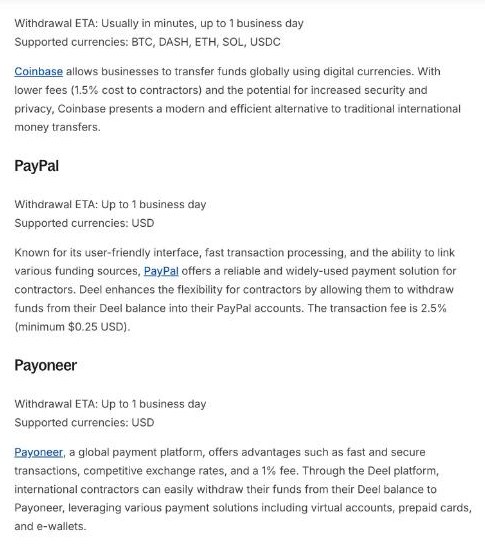
| Payoneer | Up to 1 business day | 1% |
| Coinbase | Usually minutes, up to 1 business day | 1.5% |
| PayPal | Up to 1 business day | 2.5% (minimum $0.25) |
| Instant Card Transfer | Instant (bank may take a few hours) | 2% outside the US, capped at $15; 0.75% in the US, capped at $25 |
| SWIFT | 5-7 business days | Intermediary bank fees that neither Deel nor your bank can predict |
What That Means on a $1,200 Withdrawal
To make the percentages concrete, here’s what Deel’s listed fees would take from a $1,200 withdrawal. These are Deel’s side of the fee only; the receiving service and any currency conversion can add their own costs.
- Local bank, Wise, Revolut: $0 Deel fee.
- Payoneer (1%): $12.
- Instant Card Transfer outside the US (2%, capped at $15): 2% would be $24, so the $15 cap applies. Plus any foreign exchange rate.
- Coinbase (1.5%): $18.
- PayPal (2.5%): $30.
Notice how the Instant Card Transfer cap changes the math. On small withdrawals the 2% hurts; on larger ones it’s a flat $15 at most. If you only withdraw once a month and need the money that day, a capped instant transfer can beat PayPal easily.
My Default Recommendation
If local bank transfer is available in your country and you can wait a few business days, make it your default. It’s free on Deel’s side. Remember that most banks don’t process payments on weekends and public holidays, so a Friday withdrawal may not land until the following week.
If you already use Wise or Revolut, those are the next best choices because Deel doesn’t charge a withdrawal fee for either. Wise is especially useful if you want to hold or convert currencies; I covered how a Wise Business account works for overseas clients in a separate review.
Keep Instant Card Transfer as your emergency option, and avoid SWIFT unless it’s the only route in your country. Deel itself warns that SWIFT can involve several intermediary banks whose fees come off the amount you receive.
Check Instant Card Transfer Availability First
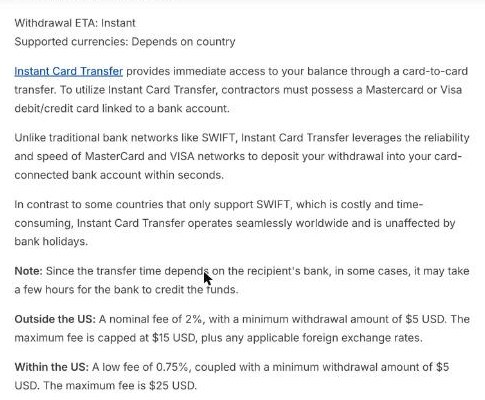
Instant Card Transfer needs a Visa or Mastercard debit or credit card linked to a bank account, and it’s only available in certain countries. Deel’s list includes, among many others, the United States, the United Kingdom, much of the EU, Mexico, the Philippines, Indonesia, Malaysia, Thailand, Vietnam, Kenya and the UAE. The minimum withdrawal is $5 in and outside the US. Deel says it’s expanding the list, so check the current version before you rely on it.
Decision 3: Do You Need the Deel Card?
The Deel Card is a Visa card funded directly from your Deel balance. Deel lists it as an instant option that works anywhere Visa is accepted. There’s a virtual card for online purchases and, in supported countries, a physical card for in-person spending. You can add it to Apple Pay and Google Pay manually.
Supported currencies, according to Deel, include USD, AUD, CAD, SGD, NZD, HKD, JPY, EUR, GBP and CHF, with availability depending on your country and card type. If you’re eligible, you’ll see a Deel Card tab under the Finance icon in your dashboard.
Who it suits: freelancers who spend part of their income on software, travel or online tools and would rather not move every dollar to a bank first. Paying a USD subscription straight from a USD balance can avoid a round trip through your local currency.
Who can skip it: if all your money goes to rent and local bills, a free local bank withdrawal is simpler. A second card is one more thing to secure and reconcile at tax time.
Decision 4: The Stablecoin Wallet, Carefully
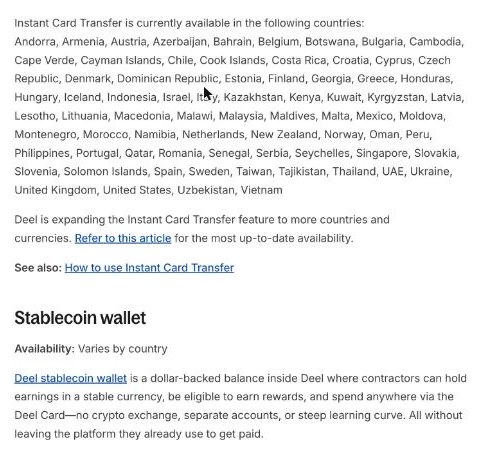
Deel also offers a stablecoin wallet in some countries. Your earnings are held as DLUSD, which Deel describes as a USD-denominated digital balance designed to track the dollar 1:1 and always redeemable for USD value inside the platform. You can move money back to your normal Deel balance instantly, with no cost, holding period or lock-up. You can also opt into an “Earn” program to become eligible for rewards, and spend the balance with the Deel Card.
Read Deel’s own disclaimer before you use it. Deel states that DLUSD is not a bank account, fiduciary deposit or legal tender, that these balances are not insured by the FDIC, FSCS or any equivalent government program, and that rewards are promotional, variable and not guaranteed, not interest or investment returns. The functionality is powered by licensed third-party partners.
My view: for freelancers in countries where holding dollars is hard, a dollar-denominated balance can be genuinely useful. But treat it as a place to park money briefly, not as savings. I’m not a financial advisor, and this isn’t financial advice; read the terms for your country and decide what level of risk you’re comfortable with.
Decision 5: When to Use Advance
Deel’s Advance lets verified contractors on Fixed or Pay As You Go contracts receive part of their earnings early. Deel is clear that it’s not a loan: there’s no interest rate and no credit check. You can make several smaller requests within one cycle instead of taking the full limit at once. The money lands in your Deel balance, and Deel automatically repays the advance from your balance when your client’s next payment arrives.
That automatic repayment is the part to plan for. If you take an advance, your next client payment will be smaller by that amount when it lands. Used once to cover a gap, it’s handy. Used every cycle, it becomes a habit of always being one paycheck behind. I’d use it only when a real expense can’t wait, and never to smooth over a client who pays late as a pattern; that’s a conversation to have with the client instead.
A Pre-Payment Checklist for New Deel Contractors
Before your first payment arrives, run through this list:
- Read your contract type and pay cycle. Know whether you’re on Fixed, Milestone or Pay As You Go, and the exact payment date.
- For Pay As You Go, agree on an approval deadline so submitted hours don’t sit unapproved.
- Set your default withdrawal method to the cheapest one available in your country, usually local bank, Wise or Revolut.
- Check whether Instant Card Transfer is available where you live, and keep it as a backup for urgent withdrawals.
- Avoid PayPal as a default unless you truly need the funds there; at 2.5% it’s the most expensive e-wallet option Deel lists.
- Decide on the Deel Card only if you’ll actually spend from your balance.
- Read the stablecoin disclaimer before moving any money into it.
- Install the Deel mobile app. Deel says contractors can view their balance, withdraw, request advances and manage the Deel Card from the app.
If you also get paid through other platforms, it’s worth comparing. My breakdown of Payoneer fees for freelancers pairs well with this one, since Payoneer is one of Deel’s withdrawal options too.
My Verdict on Deel for Contractors
From the contractor’s side, Deel is mostly a good experience, as long as you make two choices deliberately: the contract type you accept and the withdrawal method you set as default. The fee table is the whole game. A freelancer who withdraws by local bank, Wise or Revolut pays Deel nothing to get their money out, while one who defaults to PayPal gives up 2.5% of every payment.
The extras are optional. The Deel Card helps if you spend online in foreign currencies. The stablecoin wallet can help in some countries but comes with clear risk disclaimers. Advance is a safety net, not a strategy. Set things up once before the first payment, and Deel becomes a quiet, predictable part of your income.
FAQ
Does Deel charge contractors to withdraw money?
It depends on the method. Deel lists no cost for local bank transfers and no Deel withdrawal fee for Wise or Revolut, while Payoneer is 1%, Coinbase 1.5%, PayPal 2.5% and Instant Card Transfer 2% outside the US (capped at $15).
How long does a Deel withdrawal take?
Deel lists local bank transfers at 1-5 business days, e-wallets like Wise, PayPal, Payoneer and Revolut at up to 1 business day, SWIFT at 5-7 business days, and Instant Card Transfer and the Deel Card as instant.
What contract types can a contractor have on Deel?
Fixed (a set rate each pay cycle), Milestone (payment at agreed project points) and Pay As You Go (hours or tasks submitted for client approval).
Is Deel Advance a loan?
Deel says no: there’s no interest and no credit check. The advance is repaid automatically from your Deel balance when your next client payment arrives.
Is the Deel stablecoin wallet insured?
No. Deel states DLUSD balances are not insured by the FDIC, FSCS or any equivalent government program, and it is not a bank account.