
Disclosure: some links on this page may be affiliate links. If you sign up through them I may earn a commission at no extra cost to you.
Fee tables are hard to read in the abstract. “1%,” “up to 3.99% + 0.49 USD,” “1.2% – 4%” all sound small until you line them up on a real payment. So instead of listing Payoneer fees for freelancers row by row, this article follows one $2,000 client invoice through Payoneer, from the moment the client pays to the moment the money lands in your bank, and shows which fee applies at each stop.
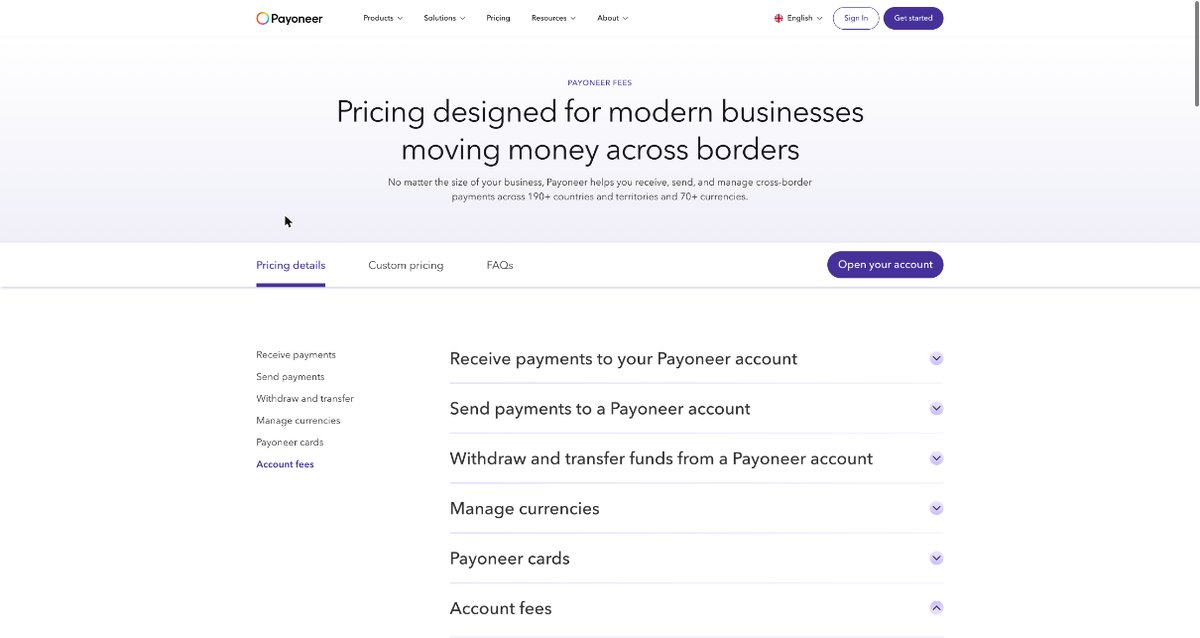
All fee figures come from Payoneer’s public pricing page, which says it was last updated on 1 January 2026. Payoneer is clear that these are its most standard fees, and that what applies to you can differ by country, account type and onboarding channel. The exact numbers for your account are shown during registration and on the Fees page when you sign in. Use this walkthrough to know which questions to ask, then check your own Fees page for the answers.
The setup: one invoice, four stops
Imagine you are a freelance designer outside the United States. A US client owes you $2,000 for a project. Your money passes through up to four places where Payoneer can charge something:
- Receiving, when the client’s payment arrives in your Payoneer balance.
- Holding or converting, if you move money between currency balances inside Payoneer.
- Withdrawing, when you send the money to your own bank account.
- The account itself, through the annual account fee and any card fees.
The total cost depends far more on how the client pays and how you withdraw than on anything else. Let’s walk it through.
Stop 1: How the client pays decides the first fee
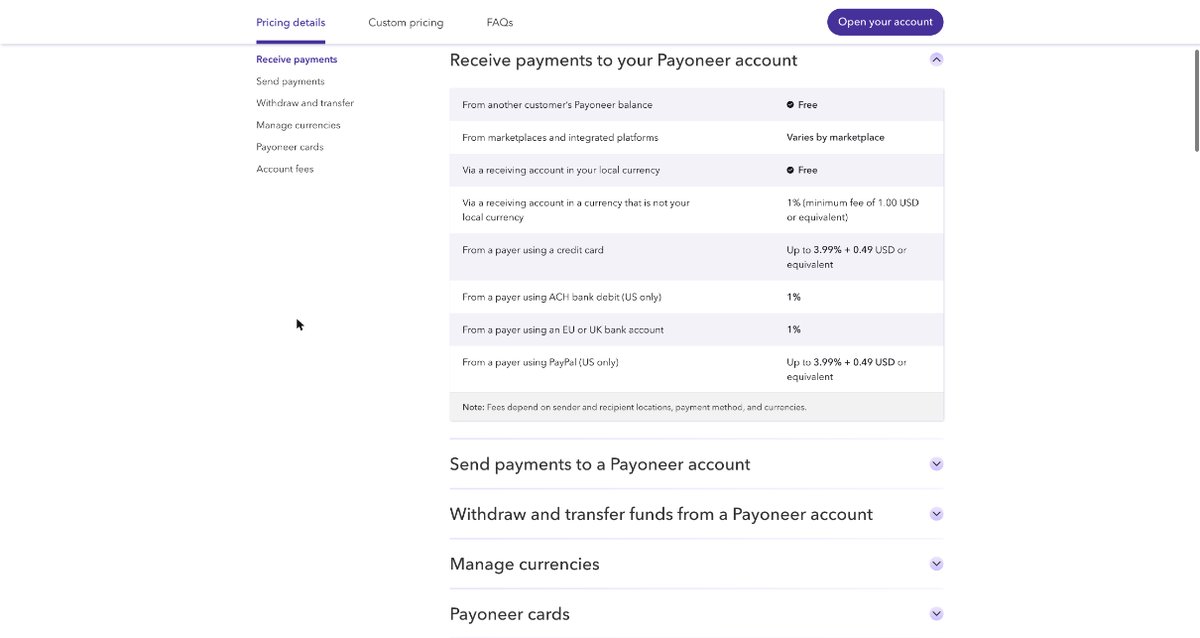
Payoneer’s “Receive payments” table lists very different costs depending on the route the money takes. Applied to our $2,000 invoice:
| How the client pays | Payoneer’s listed fee | On a $2,000 invoice |
|---|---|---|
| From another Payoneer customer’s balance | Free | $0 |
| Via a receiving account in your local currency | Free | $0 |
| Via a receiving account in a currency that is not your local currency | 1% (minimum 1.00 USD or equivalent) | $20 |
| Payer uses ACH bank debit (US only) | 1% | $20 |
| Payer uses an EU or UK bank account | 1% | $20 |
| Payer uses a credit card | Up to 3.99% + 0.49 USD or equivalent | Up to $80.29 |
| Payer uses PayPal (US only) | Up to 3.99% + 0.49 USD or equivalent | Up to $80.29 |
| From marketplaces and integrated platforms | Varies by marketplace | Depends on the platform |
The difference between the cheapest and most expensive route on the same invoice is about $80. That is the first lesson: the payment method you put on your invoice is a pricing decision.
For a freelancer outside the US receiving US dollars, the “currency that is not your local currency” row is the one to watch. A USD receiving account is convenient for American clients, but on Payoneer’s standard table it carries the 1% fee when USD is not your local currency.
What to do with this
- Steer clients toward bank transfer into your receiving account rather than card payments, when they are happy to do it.
- If a client insists on card, decide in advance whether your rate absorbs the extra percentage or whether your contract allows a payment-method surcharge where that is legal for you.
- If a client already uses Payoneer, a balance-to-balance payment is listed as free to receive.
Stop 2: Moving money between your own balances
Payoneer lets you hold several currency balances. If you move funds between them, the “Manage currencies” table lists a 0.50% fee. On $1,980 (our invoice after a 1% receiving fee), that is $9.90.
Many freelancers never need this step. It becomes relevant if, for example, you pay a subcontractor or a software subscription in euros and want to convert part of a USD payment first. If you do not need a second currency, skip the conversion and avoid the fee.
Stop 3: Getting the money to your bank
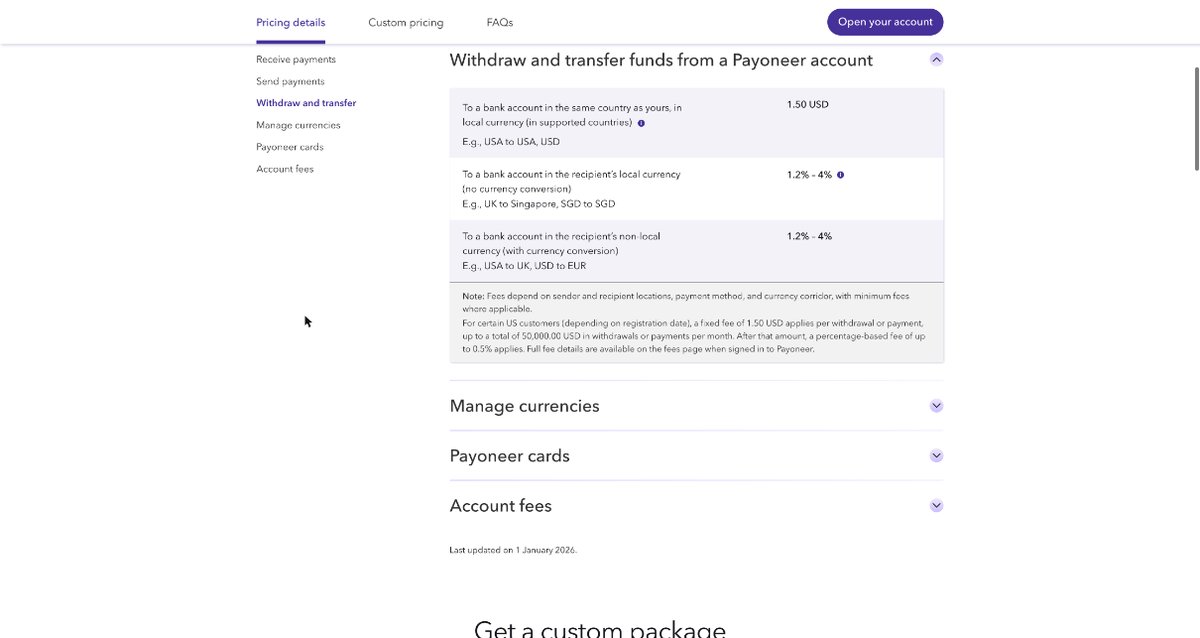
This is where the second big variable sits. Payoneer’s “Withdraw and transfer” table lists:
| Withdrawal type | Payoneer’s example | Listed fee |
|---|---|---|
| To a bank account in the same country as yours, in local currency (supported countries) | USA to USA, USD | 1.50 USD |
| To a bank account in the recipient’s local currency, no conversion | UK to Singapore, SGD to SGD | 1.2% – 4% |
| To a bank account in the recipient’s non-local currency, with conversion | USA to UK, USD to EUR | 1.2% – 4% |
Payoneer notes that fees depend on sender and recipient locations, payment method and currency corridor, with minimum fees where they apply. It also notes that some US customers, depending on registration date, pay a fixed 1.50 USD per withdrawal or payment up to 50,000 USD a month, after which a percentage of up to 0.5% applies.
For our non-US designer withdrawing about $1,980 to a local bank in a different currency, a 1.2% – 4% range means roughly $23.76 to $79.20. Payoneer’s disclaimer adds that currency conversion rates are based on wholesale market rates at the time of the transaction and include the conversion fee where indicated. In other words, the percentage is your conversion cost, so compare the amount you actually receive, not just the headline rate.
What to do with this
- Check your exact corridor on the Fees page before your first withdrawal. A range from 1.2% to 4% is too wide to plan with.
- Batch withdrawals if your corridor has a minimum fee, so one minimum covers several invoices instead of one.
- Compare the landed amount with what another provider would deliver for the same transfer on the same day.
Stop 4: The fees that are not tied to one invoice
Two more costs sit in the background:
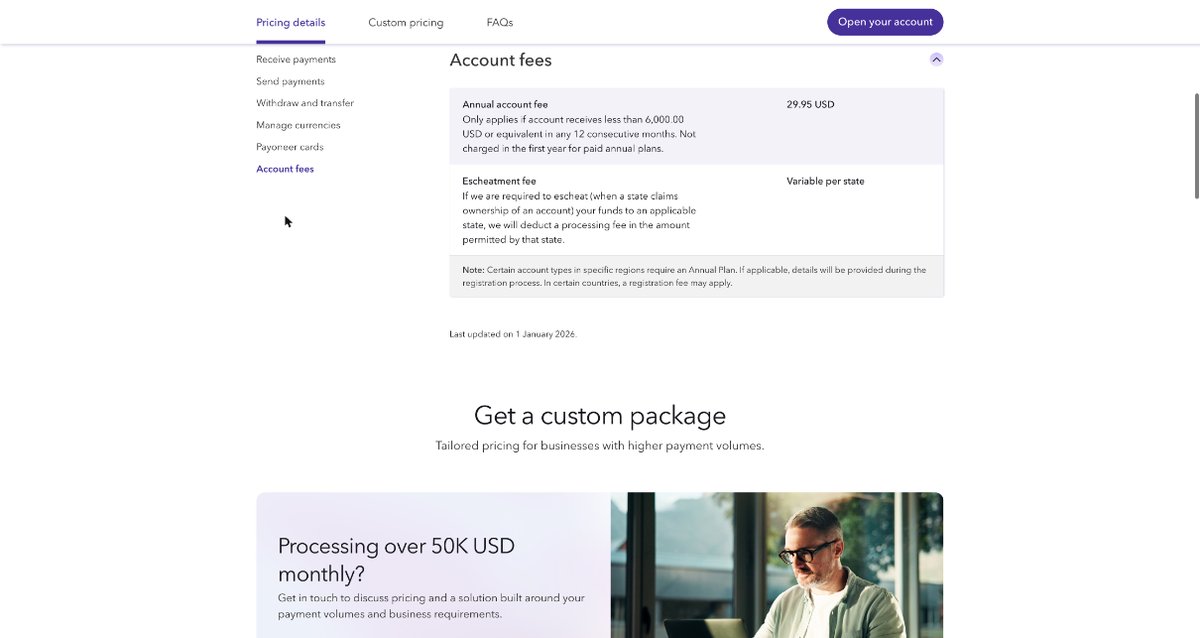
- Annual account fee: 29.95 USD. Payoneer says this only applies if the account receives less than 6,000 USD (or equivalent) in any 12 consecutive months, and is not charged in the first year for paid annual plans. A freelancer receiving one $2,000 invoice a month clears the threshold easily. Someone using Payoneer for an occasional side gig might not.
- Card fees, if you use the Payoneer card. The listed annual card fee is 29.95 USD. Card purchases without currency conversion are up to 1.8% (free where the merchant country matches the card’s issuing country), and transactions with conversion are up to 3.5%. ATM withdrawals add a fixed fee such as 3.15 USD plus a percentage.
Payoneer also notes that certain account types in some regions require an annual plan, and that a registration fee may apply in certain countries. Those details appear during sign-up.
Payoneer fees for freelancers, added up: three versions of the same $2,000
Here is the invoice end to end under three realistic scenarios, using Payoneer’s standard listed fees. These are estimates for planning, not quotes.
| Scenario | Receive | Withdraw | Approximate total |
|---|---|---|---|
| A. US freelancer, client pays from a Payoneer balance, USD withdrawal to a US bank | $0 | $1.50 | About $1.50 |
| B. Non-US freelancer, US client pays into a USD receiving account, withdrawal converted to local currency | $20 | $23.76 – $79.20 | About $44 – $99 |
| C. Same as B, but client pays by credit card | Up to $80.29 | About $23 – $77 | Up to about $157 |
The spread is the real story. The same invoice can cost almost nothing or several percent depending on two choices: how the client pays and which withdrawal corridor you use. The annual account fee and card fees sit on top, but only if you fall under the receiving threshold or use the card.
A simple checklist before you send the invoice
- Look up your own fees. Sign in and open the Fees link. Your country and account type may differ from the standard table.
- Put the cheapest payment route first on the invoice. Bank transfer to your receiving account, or Payoneer-to-Payoneer if the client has an account.
- Price card payments in advance. Either build the higher fee into your rate or agree how it is handled.
- Know your withdrawal corridor. Find out where your corridor sits in the 1.2% – 4% range and whether a minimum applies.
- Watch the 6,000 USD threshold if your Payoneer income is irregular, so the 29.95 USD annual fee does not surprise you.
- Convert only when you need to. Moving between balances costs 0.50%.
If you are pricing work on freelance marketplaces, the fees stack with platform fees too. My rate worksheet for Upwork’s per-contract service fee helps you set a price that survives both. And if you want to compare a second option for clients abroad, see my guide to getting paid with a Wise Business account.

Who Payoneer suits, judged by the fee path
Good fit: freelancers who get paid by marketplaces or clients that already work with Payoneer, those who can receive in their local currency, and anyone receiving steady income well above the 6,000 USD yearly threshold.
Think twice: if most clients will pay by card, if your withdrawal corridor sits at the high end of the conversion range, or if you only receive a few small payments a year and would pay the annual account fee.
Final thoughts
Payoneer’s fees are easiest to understand as a path, not a list. Two decisions drive most of the cost of a freelance invoice: how your client pays and how you withdraw. Get those right and the rest is small. Before your first invoice, spend five minutes on your account’s Fees page, then set your invoice’s payment instructions to the cheapest route your clients will accept.
You can review Payoneer’s current plans and open an account on the official Payoneer website.
FAQ
How much does Payoneer charge freelancers to receive a payment?
It depends on the route. Payoneer’s standard table lists free receiving from another Payoneer balance or into a receiving account in your local currency, 1% (minimum 1 USD) into a receiving account in a non-local currency, and up to 3.99% + 0.49 USD when the payer uses a credit card.
What is the Payoneer withdrawal fee to a bank account?
The listed fee is 1.50 USD for a same-country, local-currency withdrawal in supported countries such as USA to USA, and 1.2% – 4% for withdrawals to other currencies or countries, depending on the corridor.
Does Payoneer charge an annual fee?
Payoneer lists a 29.95 USD annual account fee that applies only if the account receives less than 6,000 USD or equivalent in any 12 consecutive months. It is not charged in the first year for paid annual plans.
Is there a fee to convert between Payoneer currency balances?
Yes. Moving funds between your Payoneer balances is listed at 0.50%.
Are Payoneer fees the same in every country?
No. Payoneer says fees can differ by territory, account type and onboarding channel. Your exact fees are shown during registration and on the Fees page after you sign in.